
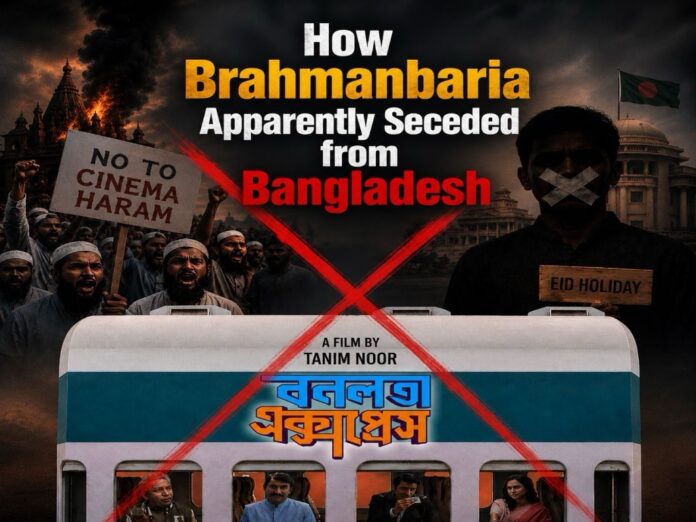
A leader of the district’s Qawmi Student Unity Council wrote, “Brahmanbaria is a city of Islamic scholars.” In a single sentence, the entire identity of the district was reduced to one narrative.
But Brahmanbaria is also the birthplace of Ustad Alauddin Khan, Al Mahmud, and Dhirendranath Datta. Yet today, the successors of that cultural heritage are being told they cannot watch a government-approved film because a group of people objected to it on Facebook.
And what did the state do?
The school authorities withdrew permission for the screening. The district administration cited the Eid holiday and concerns over law and order. Meanwhile, the BNP–Jamaat government has remained largely silent. Organisers of the screening said the event was cancelled after venue permission was revoked and administrative support disappeared.
This silence is not merely a sign of weakness. It increasingly appears to be a political calculation. The screening of the film Banalata Express in Brahmanbaria was ultimately postponed following an online campaign by members of the Qawmi Student Unity Council and other Islamist groups, despite the film being legally cleared for exhibition.
Cultural organisations have already warned that yielding to pressure from religious hardliners carries consequences far beyond a single film screening. They argue that such decisions threaten freedom of expression and Bangladesh’s cultural traditions.
Brahmanbaria has seen similar controversies before. In past years, attacks on cultural institutions and religious minorities have repeatedly raised concerns about impunity and the shrinking space for cultural expression. Critics now ask: if a film screening can be stopped today, what comes next tomorrow?
Source: bdnews24 Opinion