
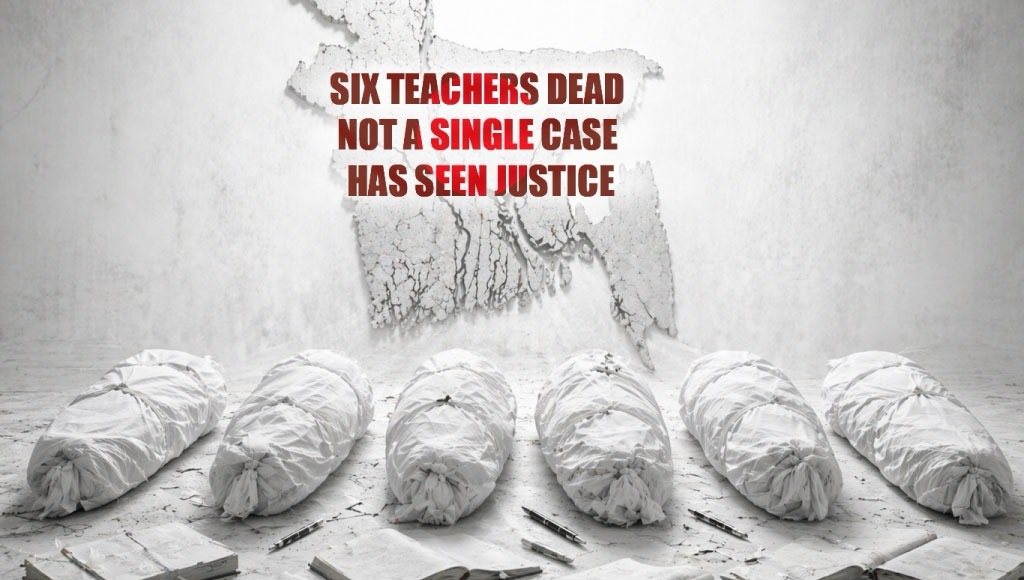
Six teachers have died. Some passed away in hospital beds, others at home. But their stories all lead back to the same place — the humiliation, fear, and isolation that engulfed them after August 2024.
Paramesh Chandra, principal of South East College in Feni, died of cardiac arrest. Abdul Khalek, a headteacher from Dohar in Dhaka, died in a hospital in Dhanmondi. Ayub, vice principal of Hazera Taju College in Chattogram, also passed away. All of them had earlier faced a similar ordeal — groups stormed their campuses, forced them to resign, drove them out, and publicly humiliated them. After that, they never truly recovered.
In Habiganj, headteacher Rezaul Karim collapsed in his chair as 10–15 outsiders barged into his office, shouting. The mob leader broadcast it live on Facebook. The image is hard to ignore — a teacher lying unconscious after a stroke, while the person responsible streams it live for an audience.
In Kishoreganj, bricks were thrown at the home of headteacher Abubakar Siddique. He fled with his family and later suffered a stroke. Nineteen allegations were brought against him, including a case accusing him of embezzling 2 million taka. A later investigation found none of the accusations to be true. But by then, the damage had already been done.
Around 3,500 teachers were harassed, incidents occurred in nearly 2,500 educational institutions, and more than 500 teachers were injured or fell ill. These figures were submitted to the Ministry of Education in February 2025. The incidents were recorded and reported — yet no effective action followed.
During the Yunus-led government period, these events showed a pattern. In many cases, mobs were aided by insiders within the institutions. Some incidents involved supporters of Jamaat, while others were driven by long-standing administrative conflicts. This mix suggests the attacks were not spontaneous — they were organized.
And what did the state do? In Shariatpur, local officials arranged a “compromise” between both sides. A teacher who had suffered a stroke was made to sit at the same table as those who attacked him — in the name of settlement. That “compromise” captures the broader failure. Where justice was needed, there was negotiation. Where protection was expected, the state remained silent or played a hollow mediating role.
Teachers went unpaid, lost their positions, became entangled in cases — and some lost their lives.
Now, in 2026, looking back, the scale of that period becomes clearer. It was not only about political upheaval. It affected people who had no role in politics — those who simply taught classes and graded papers.