
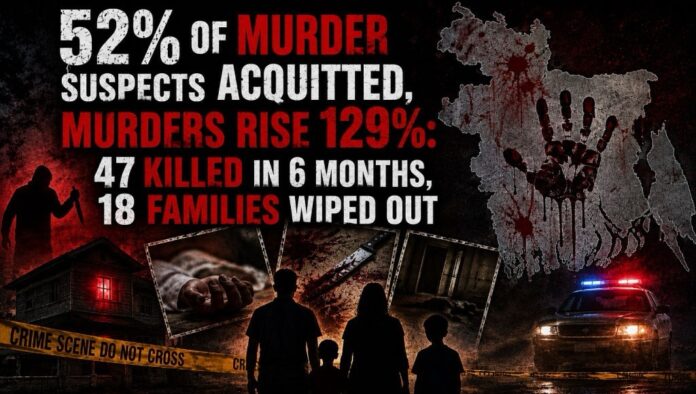
Over the past six months in Bangladesh, 47 members of 18 families have been killed in separate incidents. In Rangpur, the entire family of teacher Ganapati Chakraborty was wiped out in a single night. In Lakshmipur, a young man hacked a mother and her three daughters to death; he himself was later killed in a mob beating, yet no one still knows why he committed the murders. In Sylhet, after a 90-year-old man, his wife, and their domestic worker were killed, the story presented by police was not even believed by local residents. Revenge-driven violence is nothing new in Bangladesh, but the rate at which entire families are being wiped out is, needless to say, a “golden signature” of the rule of this BNP-Jamaat illegal occupying government.
From 2001 to 2006, during the BNP-Jamaat coalition government, murder, enforced disappearances, and terrorism received state patronage. That same alliance is back in power in 2026. And the results are right before our eyes. Murder-case statistics show that in just the first seven months of this year, there were 129 more murders than during the same period of the previous year. While the police headquarters spokesperson speaks of security, the PBI’s own research reportedly shows that defendants are acquitted in 52% of murder cases. In other words, there is little fear of punishment for committing murder. This culture of impunity is teaching people to take the law into their own hands. In Manikganj, a teenage boy’s father and uncle were killed in a mob beating while allegedly seeking revenge for the murder of a seven-year-old child. This is what justice looks like in Bangladesh today.
The question is not only about security; it is also about accountability. Under a so-called government where people are not safe even after locking the doors of their own homes, questions about the government’s legitimacy are bound to arise. Fourteen of the 18 incidents occurred inside the victims’ own homes. A home is supposed to be the final refuge, but even that has now become a stage for murder. Yet there is no outrage from those in power, no acceptance of responsibility—only attempts to manipulate the narrative by shifting around statistics. This is Bangladesh in 2026, where the shadow of the misrule of 2001–06 has once again grown darker.