
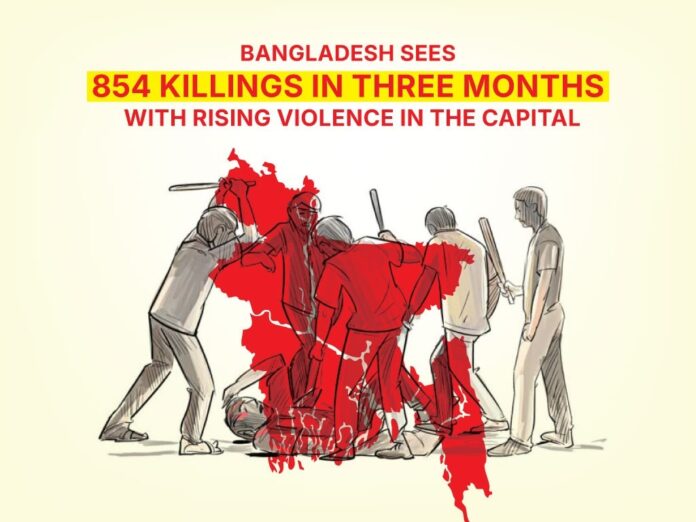
At least 854 killings were recorded across Bangladesh between January and March, according to police data, with 107 of those occurring in the capital, Dhaka.
In just the first 15 days of the current month, at least 16 killings have already been reported in the city, indicating a continuing trend of violence. March alone saw 33 killings in Dhaka, compared with 38 in February and 36 in January.
Nationwide figures show a similarly concerning pattern. According to police headquarters data, 287 people were killed in January, 250 in February, and the number rose sharply to 317 in March. Several high-profile incidents have also been reported in recent weeks.
One of the most notable incidents occurred in Rangamati, where Dharma Singha Chakma was shot dead by armed attackers. The attack took place early Friday morning in the Kutukchhari residential area. Two women, Bhagya Shova Chakma and Kripasana Chakma, were seriously injured in the same incident.
Police response
Police spokesperson AHM Shahadat Hossain said that law enforcement agencies are working to bring those involved in criminal activities under the law. He added that police are also reviewing whether individuals released on bail may be linked to recent high-profile killings.
Extortion and organised crime
Authorities and local sources say that organised criminal networks appear to be regaining strength. Some alleged crime leaders are believed to be operating from abroad, coordinating activities through phone calls and local associates.
Victims report receiving threats demanding large sums of money, often under tight deadlines. In many cases, individuals are warned that failure to comply could result in serious harm or death. Fear of retaliation has left many unwilling to report incidents to police.
Extortion is not limited to individuals. Reports indicate that organised groups are collecting significant sums daily from markets and sidewalks across the capital, while also influencing large tender processes and, in some cases, forcibly occupying property.
Funds generated through these activities are reportedly being transferred abroad through informal channels, contributing to the continued operation of these networks.
Security concerns
Security analysts warn that the resurgence of these groups is contributing to instability in Dhaka and other parts of the country. Recent incidents include shootings linked to extortion demands and violent clashes over control of lucrative contracts.
Law enforcement agencies have held multiple meetings in recent weeks, including at the Ministry of Home Affairs, aimed at addressing the deteriorating situation. A core committee on law and order has also been restructured.
Background and key figures
Sources suggest that following the political upheaval in 2024, several individuals accused of serious crimes were released on bail, with some leaving the country. Others are believed to be attempting to return or continuing to direct operations remotely.
Police say a number of individuals previously identified as “top criminals” remain active, either domestically or from abroad, often working through local associates.
Activity across the capital
Different parts of Dhaka—including Mohammadpur, Mirpur, Dhanmondi, and Karwan Bazar—have seen increased criminal activity, with reports of extortion, targeted violence, and clashes between rival groups.
Recent killings in Mohammadpur, including the fatal stabbing of a young man and the public killing of another alleged criminal figure, are believed to be linked to disputes over control and influence.
Conclusion
The latest figures and incidents highlight growing concerns over law and order in Bangladesh, particularly in the capital. While authorities say efforts are ongoing to contain the situation, the rise in killings and organised criminal activity underscores the challenges facing law enforcement agencies.