
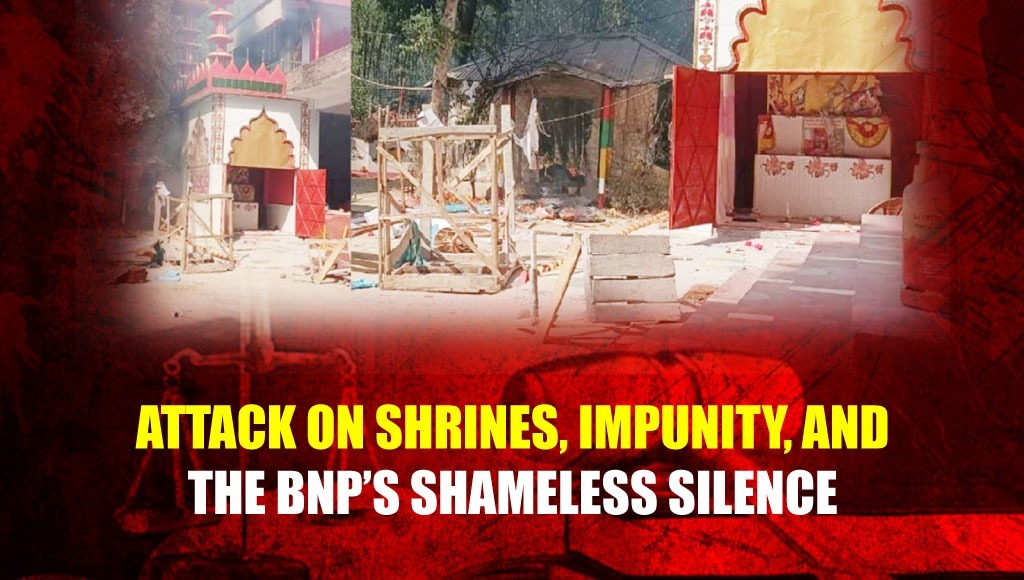
On the day Shamim Reza was beaten and hacked to death in Daulatpur, Kushtia, not a single word came from any BNP leader. A man was branded with false allegations of blasphemy, an edited video was spread, and he was killed at the hands of a mob. A shrine was set on fire. And the party that now claims to be running the country from the seat of power was busy settling other calculations.
There are serious questions about whether the election held in February 2026 can even be called an election. The country’s major political parties did not participate. Ordinary people did not go to the polling centers. What took place was essentially a staged formality, through which BNP tried to attach a label of legitimacy to it self. But the people did not accept that label.
It is worth recalling the origins of this party. Ziaur Rahman, who himself seized power through a non-participatory process, formed this party under the shadow of military rule. From the beginning, the party has carried the pretense of democracy, not democracy itself. The people of Bangladesh have witnessed its links with corruption and violence for decades—from Hawa Bhaban to extortion, tender manipulation, and grenade attacks. This history cannot be erased.
Now, coming to the attacks on shrines: since August 2024, more than a hundred shrines have been attacked. People have been killed, and over two hundred injured. In Rajbari, bodies were exhumed from graves and burned. In response to these incidents, only twelve cases have been filed. Arrests are nearly nonexistent. There is no visible progress in investigations.
In the Kushtia murder case, names of local leaders from Jamaat-e-Islami and Khelafat Majlis have emerged. Even a week after the incident, no one has been arrested. Police say the investigation is ongoing. This phrase—“investigation is ongoing”—has become the most familiar cover for impunity in Bangladesh.
BNP is now in power. It has ministers, advisors, and platforms to make statements. But when people die at shrines, no words come out. The reason is not hard to understand. The religious groups behind these attacks are tied to BNP through political equations and vote calculations. BNP’s relationship with Jamaat is nothing new. To maintain that relationship, sacrificing the people of the shrines is, for them, politically convenient.
When the caretaker of the shrine of Shukur Ali Shah Fakir in Dhamrai says, “What justice will I get? Only Allah will deliver justice,” it reflects a deep loss of public trust in the state. When a citizen gives up on seeking justice from the state, that state has effectively failed. And those in power cannot escape responsibility for that failure.
The Home Affairs advisor was unavailable—this alone summarizes the character of the government. Absent in the face of questions, absent in accountability. The Information advisor’s statement about “taking responsibility” is merely rhetorical. If taking responsibility means only issuing statements, then it makes no difference whether responsibility is taken or not.
Dhaka University teacher Abdur Razzaq Khan stated a simple truth: when justice is not delivered, criminals gain confidence. The next attack becomes easier. If after a hundred shrine attacks not a single exemplary punishment is ensured, the next attacker knows nothing will happen to them. There is no sign that this government has either the will or the capacity to break this cycle.
A government that came to power through a vote rejected by the majority—where most people did not participate—lacks both the moral courage and political will to ensure the safety of religious minorities or people associated with Sufi shrines. In the equations it has built to sustain itself, these people have no place.
This is the harshest truth about Bangladesh at this moment.