
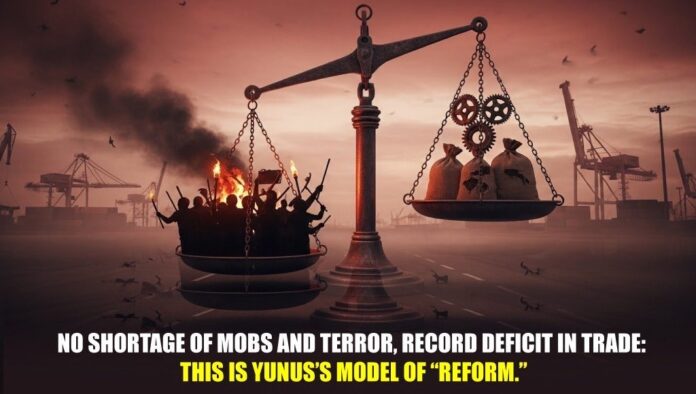
In just the first five months of the current fiscal year, the trade deficit has reached $9.4 billion. Do you know what that figure becomes when calculated in local currency? Around Tk 1.13 trillion. But written in dollars, the number looks smaller, doesn’t it? Just the way this illegal government tries to downplay all of the country’s problems.
Given the direction the country is heading, comparing it to Somalia no longer seems like an exaggeration. In July, nationwide riots were orchestrated and an elected government was overthrown in a coup. Since that illegal seizure of power, the economy has hit rock bottom. Export earnings are falling, imports are rising, and the trade deficit keeps widening. Yet Mr. Yunus and his so-called reform government appear to have no concern at all.
It is no longer a secret that foreign funding, support from Islamist militant groups, and the silent backing of the military were behind installing this usurious moneylender in power. The entire episode was a carefully planned conspiracy—and now the people of the country are paying the price every single day.
Data show that compared to the same period of the previous fiscal year, the deficit this year is 15.66 percent higher. Imports have increased by 6.1 percent, while export earnings have risen by only 0.6 percent. Where does such a dangerous imbalance lead a country? What better way is there to break the backbone of an economy?
From August to December, export earnings fell for five consecutive months. The ready-made garments sector—the lifeblood of the economy—is in recession. October to December is usually the peak season, yet the expected growth did not materialize this time. In December alone, export earnings dropped by 14.25 percent. Why is this happening? Because global buyers are afraid to place orders in Bangladesh amid such instability. When a country is plagued by mob violence, militancy, and political turmoil, who would invest there?
A trade deficit is apparently not a problem—but there must be no shortage of mob terror! That, after all, is Yunus’s version of reform. Terror reigns on the streets, law and order have collapsed, and this so-called government remains busy pushing the country deeper into the abyss in the name of reform.
Meanwhile, there is an aggressive state-backed campaign urging people to vote “yes.” Vote yes—for what? So that Yunus and his patrons can finish destroying Bangladesh. To completely ruin a country, you first destroy its economy—and that is exactly what is happening now. Dollar reserves are shrinking, the taka is depreciating, prices of essentials are rising, and ordinary people are being crushed between the millstones.
In fiscal year 2022–23, the trade deficit stood at $27.38 billion. The following year it declined to $20.45 billion. But after this illegal government came to power, the deficit has begun to rise again. Is this a coincidence? Not at all. This is planned devastation.
Exporters claim the problem stems from retaliatory tariff policies of U.S. President Donald Trump. But Trump was in office before as well—did exports collapse like this then? The real problem is internal instability, created and sustained by this coup government for its own interests.
The microcredit empire built in Yunus’s name—how should we account for what was extracted from poor people in the name of interest? Does this usurious moneylender now want to turn the entire country into debt slaves? Where exactly is he taking the nation’s economy?
The sharp rise in export earnings seen in July was the result of work done by the previous government. But the continuous decline in the months that followed is the wrongdoing of this illegal regime. Over six months, export earnings have fallen by 2.19 percent. This is not a minor issue—it is a sign of national catastrophe.
Today the country stands at a crossroads. On one side, an economic crisis; on the other, political instability. And in between sits an illegal government with no popular mandate and no moral right to govern. Yet it survives on the grace of foreign masters, the support of militants, and the silent cooperation of the military.
Who will take responsibility for this situation? Will Yunus and his so-called reform government ever be accountable to the people of the country? Or is submitting reports to foreign patrons their only job?