
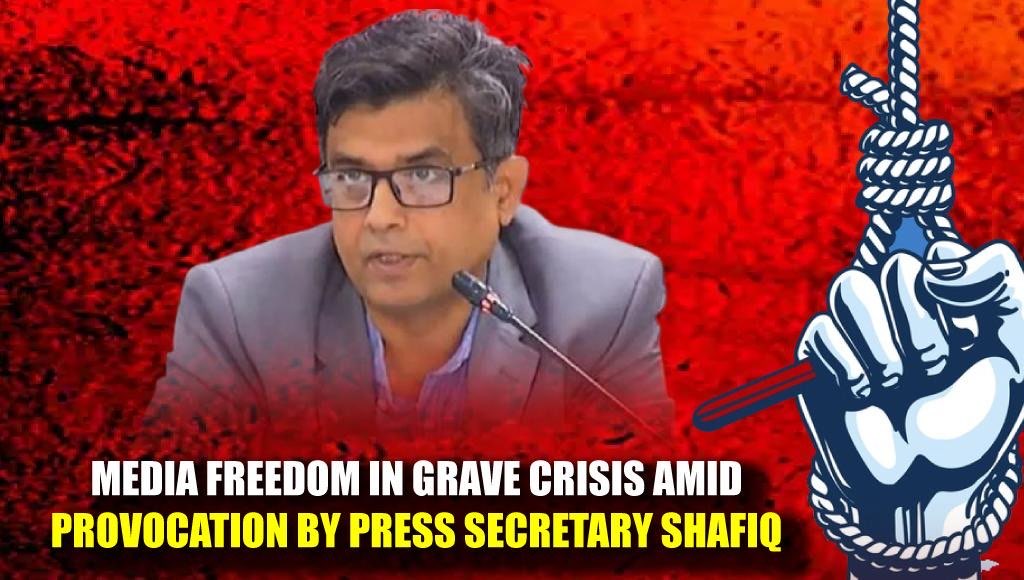
Media freedom in Bangladesh is now on the brink of death. Under the leadership of Chief Adviser of the interim government Dr. Muhammad Yunus, the country is sliding into a deep abyss of chaos and extremism. The latest and most alarming example came on the night of December 18–19, when a frenzied mob carried out brutal attacks, vandalism, and arson at the offices of two of the country’s leading media outlets, Prothom Alo and The Daily Star, in Karwan Bazar, Dhaka. Journalists were trapped in thick smoke, screaming in fear for their lives, while equipment and documents were reduced to ashes. As a result, both newspapers were forced to suspend their print and online operations temporarily. This marks a shameful and dark chapter in the history of Bangladeshi journalism. Prothom Alo’s Executive Editor, Sajjad Sharif, described it as “the darkest night in the history of newspapers.”
This attack was not an isolated incident but the outcome of a planned policy of repression. According to a report by the Rights and Risks Analysis Group, during the first eight months of Dr. Yunus’s government, from August 2024 to March 2025, 640 journalists were targeted, a 230 percent increase compared to the previous government. That number has since risen to 878. Data from Ain o Salish Kendra shows that in 2025 alone, hundreds of incidents of attacks and harassment against journalists have taken place. International organizations including Human Rights Watch and the Committee to Protect Journalists have condemned this repression as a “direct assault on media freedom.” The misuse of anti-terrorism laws to arrest, remand, and imprison progressive journalists continues unabated.
At the heart of this chaos lies the interim government’s extreme failure and inaction. Having come to power promising reforms, Dr. Yunus has proven completely incapable of maintaining law and order. By allowing extremist groups free rein, the country is being pushed into disorder. While BNP leaders have condemned the attacks, they have squarely blamed the government’s inaction.
Most alarming is the role of Press Secretary Shafikul Alam, who has been creating mob pressure against the media, placing journalists under constant threat. By repeatedly accusing the media of “distorting information” and “misquoting,” he has incited anti-media sentiment among the public. He has even attempted to legitimize protests by labeling them “pressure groups,” a move that directly encourages violent attacks. His conduct has become a primary source of mob threats against journalists and forms part of the government’s repressive approach. As a result, journalists are working in an atmosphere of extreme insecurity and fear.
Analysts say the Yunus government has failed to control mob rule, pushing the country under the shadow of extremism. Experts speaking on condition of anonymity have described the situation as a clear reflection of the government’s utter failure to uphold law and order. International media freedom organizations have strongly condemned the attacks and demanded an immediate and credible investigation.
Democracy, freedom of expression, and the very existence of independent media are now under serious threat in Bangladesh. Progressive voices are being silenced, and journalists are facing intimidation, violence, and repression. If the press secretary’s provocations and the government’s inaction are not stopped, the country will sink further into the depths of extremism and chaos. The international community must exert strong pressure on this government to ensure genuine democratic reforms, protection of the media, and accountability for those responsible.