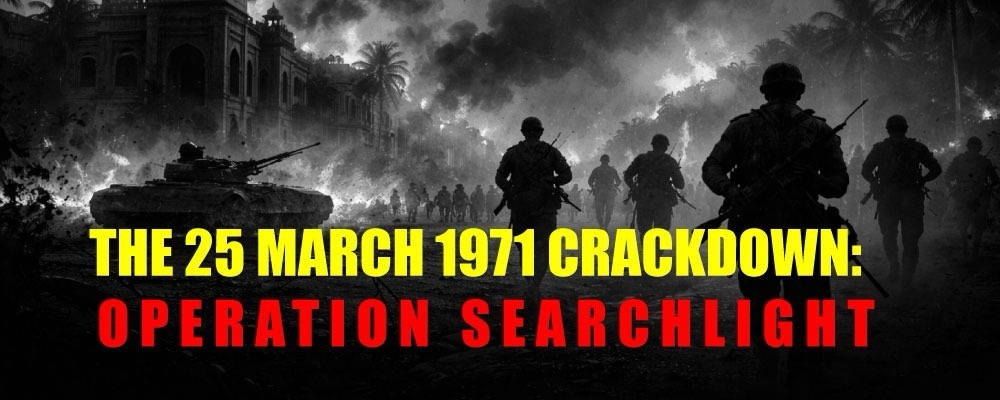
On the night of 25 March 1971, the Pakistani military launched a coordinated and brutal crackdown in what was then East Pakistan, now Bangladesh. The operation, codenamed Operation Searchlight, marked the beginning of one of the darkest chapters in South Asian history.
Background
Tensions had been escalating for months following the victory of the Awami League in Pakistan’s 1970 general elections. Led by Sheikh Mujibur Rahman, the party had secured a majority, but power was not transferred by the central government in West Pakistan. Political negotiations failed, and unrest spread across East Pakistan.
The Night of 25 March
Late on 25 March, Pakistani forces moved into the capital, Dhaka, under orders to suppress Bengali nationalism. Tanks and troops were deployed across key areas. The army targeted civilians, students, intellectuals, and political activists.
One of the primary targets was the University of Dhaka, where students and faculty members were attacked in their dormitories. Many were killed. Residential neighborhoods, including densely populated areas, were shelled and set on fire.
The operation quickly expanded beyond Dhaka to other cities and towns, following a similar pattern of violence.
Arrest of Leadership
In the early hours of 26 March, Sheikh Mujibur Rahman was arrested at his residence. Before his arrest, he is widely believed to have declared the independence of Bangladesh, a message that was later broadcast from Chittagong.
Armed Resistance and Liberation War
In response to the crackdown, resistance rapidly evolved into an organized armed struggle. Civilians, students, and defected members of the police and military formed guerrilla units under the banner of the Mukti Bahini. Despite limited resources, they carried out coordinated attacks on military installations, communication networks, and supply lines. The conflict soon escalated into the Bangladesh Liberation War, drawing widespread support from the population. After months of fighting, and with the eventual involvement of India, the war ended in December 1971 with the defeat of Pakistani forces and the establishment of an independent Bangladesh.
Human Impact
The crackdown resulted in widespread loss of life. Although exact figures remain disputed, it is widely accepted that thousands were killed in the initial days. The violence also forced millions of people to flee their homes, many seeking refuge in neighboring India.
International Reaction
At the time, international response was limited. However, foreign journalists and diplomats later documented the scale of the atrocities, bringing global attention to the events.
Legacy
The events of 25 March are commemorated in Bangladesh as Genocide Day. The crackdown is widely regarded as the beginning of a systematic campaign of violence against the population of East Pakistan. It remains a defining moment in the country’s struggle for independence and is remembered as a night of profound tragedy and resistance.