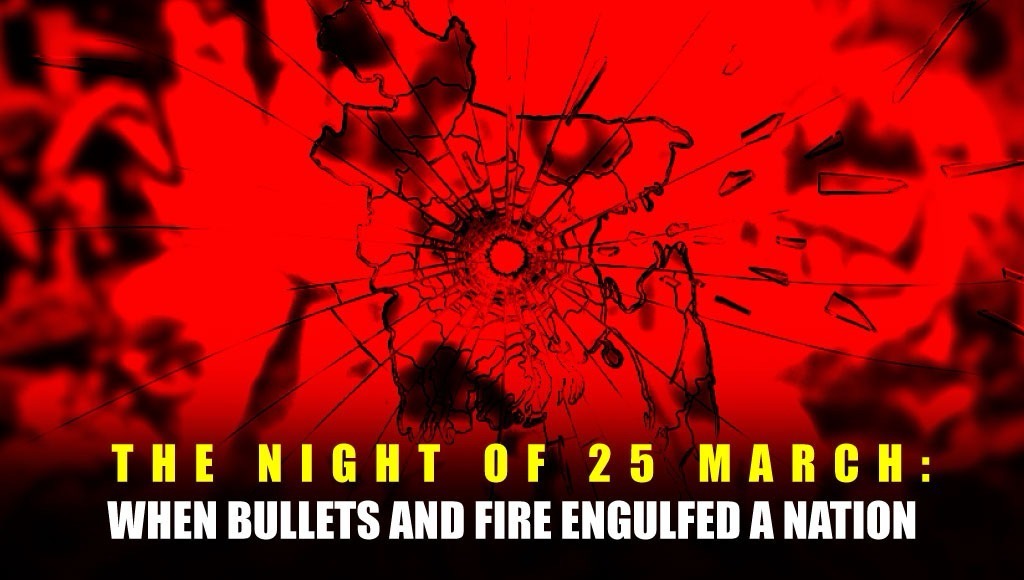
On 25 March 1971, an ordinary spring night turned within hours into one of the most brutal episodes in modern history. Under an operation known as Operation Searchlight, the then Pakistani military junta launched a massive assault on unarmed, sleeping Bengali civilians. The attacks, carried out by a well-equipped and organised army, is widely regarded as one of the most severe and condemned acts of violence of its kind.
Despite securing an overwhelming majority in the 1970 general election, Bengali leaders were denied the transfer of power. Talks led by Yahya Khan and Zulfikar Ali Bhutto continued amid delays, while, behind the scenes, military planners prepared for a large-scale crackdown.
On the evening of 25 March, President Yahya Khan quietly left Dhaka. Shortly afterwards, Pakistani troops moved out from the cantonment with tanks and heavy artillery , launching coordinated attacks across the city. What followed has been described by many as a profound betrayal, as negotiations gave way to widespread violence against civilians—actions that meet the definitions of war crimes and crimes against humanity.
Key targets included University of Dhaka, Rajarbaug Police Lines, and the EPR HQ in Pilkhana. Dhaka was brought to a standstill under intense shelling and automatic gunfire.
Violence on campus
At residential halls including Jagannath Hall and Iqbal (later Zahurul Haq) Hall, troops entered dorms and shot sleeping students. Teachers and their families were also killed . University campuses was left strewn with bodies.
Initial armed resistance
At Rajarbaug, Bengali police officers attempted to resist using .303 rifles, but were quickly overwhelmed by the superior firepower of the Pakistani troops. The barracks were subsequently set ablaze.
Fires in Old Dhaka
In densely populated areas such as Shankharibazar, fires were deliberately set, reportedly using accelerants. Thousands of men, women and children—were killed either by gunfire or in the flames.
Although foreign journalists were expelled from Dhaka , some remained in hiding. Simon Dring of The Daily Telegraph reported on the atrocities to the outside world. Meanwhile, Archer K. Blood described the killings as a “selective genocide” in official communications, drawing international attention to the scale of the violence.
Pakistani military leaders reportedly believed that overwhelming force would suppress Bengali nationalism within a single night. However, this assessment proved wrong. Rather than ending the movement, the crackdown intensified resistance. Shortly before his arrest in the early hours of 26 March, Sheikh Mujibur Rahman declared the independence of Bangladesh, marking the beginning of the Liberation War.
The events of 25 March are widely seen as a reflection of deep political failure, ethnic hostility, and extreme violence by the Pakistani rulers . While the night left lasting scars on the Bengali people, it also became a turning point that ultimately led to the emergence of an independent Bangladesh. Many continue to call for broader international recognition of the atrocities committed during that time.