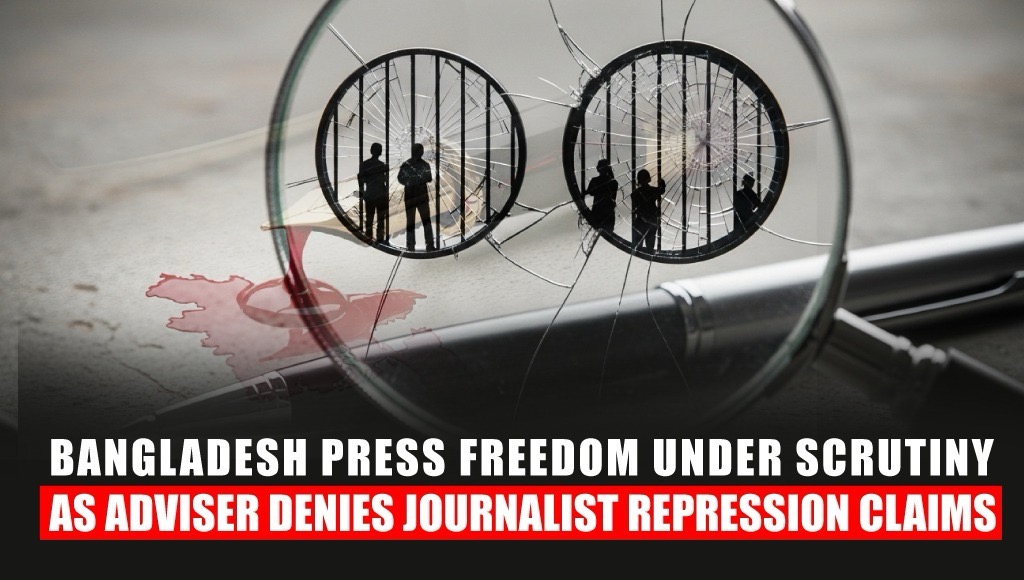
Rezwana has claimed that no journalists have faced repression under this government.
Very well. Then who beat Khondkar Shah Alam to death? Who hacked Asaduzzaman Tuhin to death? Who set fire to the offices of Prothom Alo and The Daily Star? Why is Farzana Rupa languishing in jail under nine cases? Why is Mozammel Babu, a cancer patient, dying in prison?
Will Rezwana answer these questions? Or are these all imaginary?
The real problem of the Yunus government is that it believed once in power, everything could be erased—that people would forget. But international human rights organizations have documented everything. From the Committee to Protect Journalists to Reporters Without Borders, from the International Federation of Journalists to Human Rights Watch, all have presented a picture of journalist repression in Bangladesh that lays bare Rezwana’s denial.
This government came to power in July 2024, after unrest and the ousting of an elected administration. In just eighteen months, the state of Bangladesh’s media has deteriorated in ways unseen in decades. The Yunus government is, critics say, throttling the press directly.
Let’s look at the numbers. Transparency International Bangladesh reports that between August 5, 2024 and November 2025, in just fifteen months, 1,073 journalists were affected in 476 incidents. The South Asia Press Freedom Report 2024–25 by the International Federation of Journalists states that six journalists were killed during this period. Bangladesh now ranks second in South Asia for journalist killings, after Pakistan.
Criminal cases have also surged. Compared to 2023, cases against journalists in 2025 increased by 558 percent—more than fivefold.
This is the reality behind Rezwana’s claim that “no repression occurred.”
On the night of December 18, a date that will remain a dark chapter in Bangladesh’s media history, thousands gathered in Karwan Bazar after news spread of the death of Sharif Osman Hadi, convener of the Inqilab Mancha. Protesters stormed the Prothom Alo building, vandalized and looted it, then set it ablaze. The building burned for over three hours. A few hundred yards away, the The Daily Star office faced the same fate. Twenty-eight journalists and staff were trapped on the roof before being rescued by firefighters.
For the first time in 27 years, Prothom Alo could not publish. For the first time in 33 years, The Daily Star ceased operations.
During the attack, the army and BGB reportedly stood outside. They did nothing as the buildings burned. Only after the attackers left did they attempt to disperse the crowd.
What should this be called—inaction, or silent consent? The Committee to Protect Journalists and five other international organizations demanded an investigation in a joint statement. UN Special Rapporteur on freedom of expression Irene Khan called it “extremely dangerous.” EU Ambassador Michael Miller described it as “a terrible moment for Bangladesh’s democracy.”
Yet Rezwana insists there has been no repression.
Consider the killings. Khondkar Shah Alam, a journalist from Dainik Matribhumi in Nabiganj, was beaten after reporting on a former convict known as “Bagha Babul.” He later died. Reporters Without Borders and the International Federation of Journalists condemned the attack. Was there justice?
Asaduzzaman Tuhin, a reporter for Dainik Protidiner Kagoj in Gazipur, was filming alleged extortion on August 7, 2025. When he refused to stop recording, he was chased down and hacked to death. The Committee to Protect Journalists demanded an immediate investigation. Was there one?
Farzana Rupa and Shakil Ahmed, journalists from Ekattor TV, were dismissed from their jobs and later arrested under murder charges. Farzana now faces nine murder cases. In court, she reportedly said, “If you want to frame me, one murder case is enough.” In March 2025, three UN Special Rapporteurs formally wrote to the government seeking clarification. Has there been a response?
Mozammel Babu, Managing Director and Editor of Ekattor TV and a cancer patient, was arrested and remanded in a murder case. The Human Rights Watch World Report 2025 described such detentions as “arbitrary arrests” and “denial of due process.”
According to the Committee to Protect Journalists, more than 140 journalists face murder charges. Twenty-five are linked to investigations at the International Crimes Tribunal. Reporters Without Borders says five journalists are imprisoned without investigation on such allegations.
Accreditation cancellations have also surged. Reporters Without Borders reports that 107 accreditations were revoked in 2025 alone, with 59 journalists labeled as “supporters of the former government.” Human Rights Watch estimates nearly 200 cancellations. According to The New Humanitarian, over 300 journalists face travel bans.
Bangladesh now ranks 149th out of 180 countries in the World Press Freedom Index by Reporters Without Borders. The International Federation of Journalists calls it the second most dangerous country in South Asia for journalists.
Are all these organizations lying? Are CPJ, RSF, IFJ, HRW, the United Nations, and the European Union conspiring against Bangladesh?
Critics argue that the government’s lack of democratic legitimacy has led to systematic repression. To remain in power, it must silence journalists. Because if journalists report the truth, the public will know. And if the public knows, they may protest. And if they protest, this government may not survive.
Renowned photojournalist Shahidul Alam told The New Humanitarian, “Before, the fear was of the government; now the fear is of the street, the mob, political parties.” But who unleashes the mob? Why did security forces stand by during the attacks on Prothom Alo and The Daily Star?
The answer, critics say, is that the mob functions as a proxy. The method has changed; the objective remains the same—silencing journalists.
Rezwana says there has been no repression. Very well. Then release Farzana Rupa. Release Shakil Ahmed. Provide treatment to Mozammel Babu. Investigate the attacks on Prothom Alo and The Daily Star. Bring the killers of Khondkar Shah Alam and Asaduzzaman Tuhin to justice.
Can that be done? Or would that expose the truth?
Lies may persist for a time. But documented facts remain. Six journalists killed. 1,073 affected. Offices burned. Cases up 558 percent.
History keeps records. And one day, there will be accountability—for every slain journalist, every imprisoned reporter, every torched newsroom.
Rezwana says there has been no repression.
How long can that claim stand? Truth may not prevail today, or tomorrow—but one day, it will.