
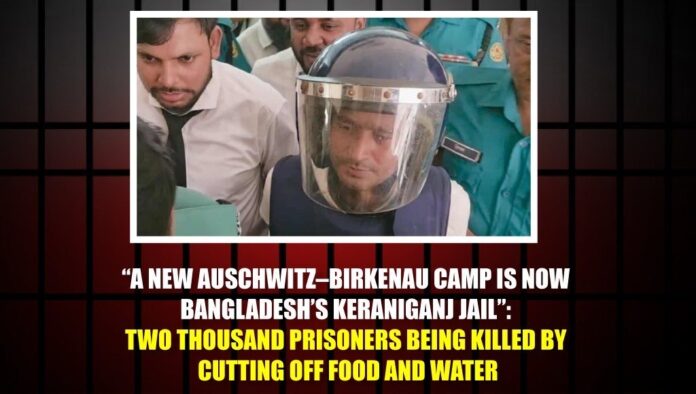
Reports of a humanitarian catastrophe are emerging one after another from inside Dhaka Central Jail. In Keraniganj Prison, nearly two thousand inmates have been locked inside their cells since 3 January for an indefinite period. They are being deprived of food, water, and basic facilities. This information has emerged through confidential sources from inside the prison.
Between 1,800 and 2,000 prisoners in the Shapla, Bonful, and Surjomukhi blocks are being kept under 24-hour cell confinement. This is completely contrary to prison law. Regular food and water supplies to the prisoners have been stopped. They are being denied even the basic rights that an arrested person is entitled to.
A message sent from inside the prison says that the prison authorities are carrying out this repression in complete violation of the law. This behavior is inhuman and constitutes crimes against humanity. Nearly two thousand people are now spending their days under these conditions. However, the message that has been sent outside has raised serious concerns because of the disclosure of specific identities and information. Prisoners’ safety inside the jail is already in question, and in such a situation public identification could become a threat to life.
In recent months, there have been a series of suspicious deaths in Bangladesh’s prisons. The rate of death among Awami League leaders and activists in particular is alarming. In many cases these are being described as heart attacks or natural deaths, but doctors and family members have expressed doubts. In some cases there is discussion of the possible use of toxic substances derived from foxglove plants. Such poisons can stop the heart’s function and do not appear in routine tests.
Since the interim government led by Muhammad Yunus came to power, allegations have increased of intensified repression against Awami League leaders and activists. Mass arrests are being carried out under the name “Operation David Hunt.” Thousands of people are being detained. Many are disappearing. Some are later found dead. Killings by mob violence are also occurring openly, while law enforcement agencies often remain silent spectators.
The party that led Bangladesh’s struggle for independence now finds its leaders and activists unsafe even within the country. For the first time since 1975, Awami League members are being targeted on such a massive scale. Many say this is not merely political revenge but a planned campaign of elimination.
The previous government fell in July through a bloody wave of riots in which thousands were injured and killed. Who was behind that movement, who financed it, and which forces supported it are still unclear. But the ideological stream of those now close to power has historical links to opposition to the Liberation War of 1971.
International human rights organizations should urgently investigate what is happening inside Bangladesh’s prisons. Under the UN Standard Minimum Rules for the Treatment of Prisoners, every prisoner has the right to food, water, medical care, and time outside the cell. None of this is being respected in this Dhaka jail. Not only that, the prisoners’ lives themselves are now at risk.
The United Nations, Amnesty International, Human Rights Watch, and other organizations should demand access to Dhaka Central Jail. Independent medical teams should be sent. Forensic investigations should be conducted to determine the real causes of prisoner deaths. It is not enough to simply rely on government statements.
What is happening inside the prison is not just a problem for the prisoners. It is an indicator of the country’s overall human rights situation. A government that cannot ensure humane treatment in its prisons and cannot protect prisoners’ lives cannot protect the rights of ordinary citizens either.
These two thousand prisoners are now in a kind of silent detention camp. Their voices are not reaching outside. Even the message that has come out may have been sent at great risk. The question now is whether sending that message will put the sender and others with him in even greater danger.
The Yunus government now bears responsibility for explaining this situation. Why is this behavior occurring in prisons? Why is prison law not being followed? What are the real causes of the prisoners’ deaths? And above all, what has happened to the promise of human rights on which this government came to power?
Bangladesh now stands at a crossroads. A country born with dreams of democracy and human dignity is now witnessing a struggle over prisoners’ lives inside its jails. If this situation is not reversed, history will not forgive it. The responsibility of the international community is now to speak out rather than remain silent. Otherwise, no one will be able to account for how many more people will fall victim to this silent slaughter.