
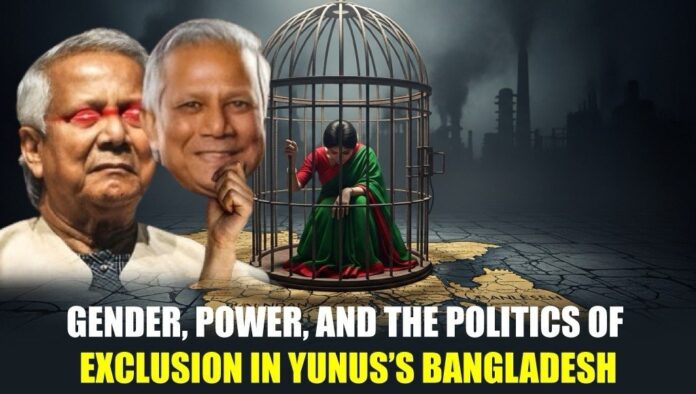
After the bloody riots of July, when Dr. Yunus came to power, his supporters claimed a “new Bangladesh” had begun. Democracy would be restored. Women would be empowered. Everything would change. But what is the reality? In the election he is preparing to hold, women make up only three percent of the candidates. That single number is enough to reveal what this so-called new Bangladesh really looks like.
The man who won a Nobel Prize in the name of empowering women through microcredit is now, after coming to power, arranging a system that deprives women of their political rights. What a striking contradiction. On one hand, he speaks of women’s empowerment. On the other, women are almost entirely absent from the election being held under his supervision. Is this just a coincidence? Or is it deliberate?
Yunus came to power with the backing of Islamist parties, and the price of that support is now being paid. For Jamaat, Hefazat, and other fundamentalist groups, women participating in politics is unthinkable; even stepping outside the home is considered sinful. So it is no surprise that none of these parties have female candidates. What is truly shocking is that Yunus seems completely unconcerned about this reality. Because the very foundation of his power rests on these forces.
In a country where women once fought with weapons in the Liberation War, where women took to the streets during the Language Movement, today women may have the right to vote but not the right to stand as candidates. What kind of democracy is this? The election Yunus is planning is not really an election at all. It is a farce. And the biggest farce is that in this entire system, women are treated only as a vote bank, with no right to make decisions.
The consequences of an illegal seizure of power backed by foreign funding and direct military support are now being felt by the people. A government formed on the blood of those martyred during the bloody days of July has made it clear how much importance it places on women’s rights.
There is no place for women in Yunus’s so-called reform process. A man who spent his life collecting interest from poor women and won a Nobel Prize now sees women only as a source of profit, not as human beings deserving of dignity. That women are sidelined in this election is therefore hardly surprising.
Bangladesh is being dragged toward a future where women’s rights, dignity, and freedom are all under threat. Just as the Taliban have confined women to their homes in Afghanistan, just as women in Yemen are stripped of all rights, just as women in Syria live in dire conditions, Bangladesh is heading down the same path. And leading this journey is the very man who claims to be a champion of women’s development.
The truth is simple. For Yunus, holding on to power matters more than women’s rights. To keep the fundamentalist forces that brought him to power satisfied, women’s rights must be sacrificed. And that is exactly what he is doing. The presence of only three percent female candidates is proof of this.
In a country where nearly half the voters are women, what does it mean when only three percent of candidates are women? It means the election is one-sided from the very beginning. There is no intention to hear women’s voices, no willingness to accept women’s leadership. Women will vote, and men will rule. That is Yunus’s model of democracy.
The most tragic part is that the very women who took part in the July movement, who came out onto the streets, who cared for the wounded, now have no place in politics. In return for their sacrifice, they have received only neglect and contempt. To Yunus, they are merely numbers, not human beings.
Bangladesh’s history is rich with the contributions of women. But the current rulers have forgotten that history. To them, women matter only when their votes are needed. Beyond that, women are disposable. And with this mindset, the country is being run.
The election Yunus is preparing will be a staged drama. And in this drama, women have no role. They are merely spectators. And by remaining spectators, women will lose their rights, their dignity, and their freedom. And who bears responsibility for this loss? Those who seized power illegally with foreign money and military backing.
Bangladesh now stands at a crossroads. Whether the country moves forward or backward depends on this election. And an election with no representation for women can never lead a country forward. A nation that ignores half of its population can never truly progress.
When this farce of Yunus will end, only time will tell. But the damage Bangladeshi women will suffer in the meantime may take decades to repair.